
Reverberation and comet-tail artifacts
| View | Any 2D view; common behind the LAA ridge, in the ascending aorta, and distal to mechanical prostheses, leads and catheters. |
|---|---|
| Timing | The ghost moves along the same axis as the source and in step with it. |
| Caliper / trace | Not measured: compare depth (ghost at twice the source depth), motion and anatomic boundaries. |
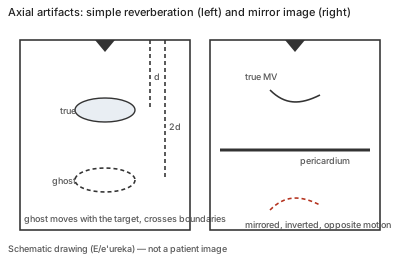
Correct example
A simple reverberation appears coaxial with and equidistant beyond a strong reflector, crossing anatomic boundaries; a comet tail is a tapering trail of lines behind two close reflectors such as mechanical leaflets.
Common error
Reading the ghost of the LAA ridge as thrombus, or an ascending-aorta reverberation as a dissection flap.
Effect on interpretation
Misdiagnosis can lead to unnecessary anticoagulation or surgery; the comet tail of a mechanical mitral prosthesis masks the LA on TTE and can prevent colour assessment of prosthetic MR.
Why
The system assumes a single round trip; a second trip to a strong reflector doubles the travel time, so the echo is mapped twice as deep. Change the angle or window, lower gain, and use 3D, contrast or CT/CMR when the artifact cannot be separated from anatomy.